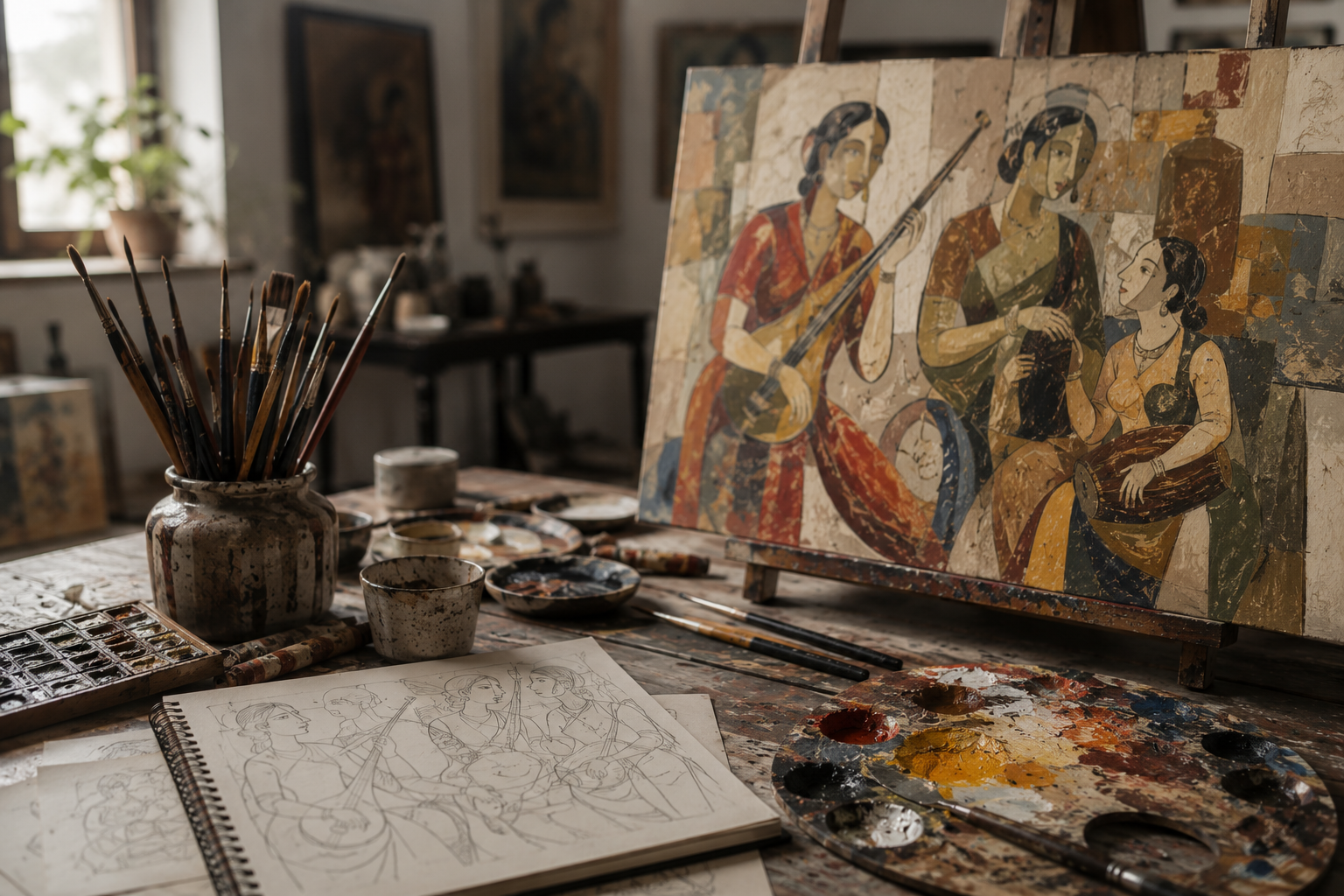
Every painting begins before the first brushstroke
A finished artwork carries the evidence of many decisions that remain invisible to the viewer. Before colour reaches the surface, there is observation, memory, research, drawing, revision and—often—long periods of quiet thought.
At Ceramic Raja, a painting is never approached as decoration alone. It begins with the search for a visual language capable of holding an idea, an emotion or a cultural memory. Some works grow from music and rhythm; others emerge from relationships, architecture, Indian traditions, symbolic forms or moments observed in daily life.
The first brushstroke therefore does not mark the true beginning. By the time it appears, the painting has already lived in the artist's mind through several possible forms.
“An artwork is complete when every colour, form and silence has found its place.”Ceramic Raja Studio
The path from an idea to a finished work
The first idea
A painting may begin with a memory, a cultural symbol, a musical rhythm, a relationship, or an emotion that continues to return. The idea is allowed to mature before any permanent mark is made.
Sketch and composition
Pencil studies explore the placement of figures, movement, balance and negative space. Several arrangements may be tested before the composition begins to feel natural.
Colour decisions
The palette is chosen for emotional purpose. Earth tones can create warmth and familiarity, blues can introduce quietness, and stronger reds or golds can bring energy and ceremonial presence.
Layering and texture
Transparent washes, mid-tones, thicker passages and fine details are built gradually. Each layer responds to the one below it, allowing unexpected textures and relationships to emerge.
The final pause
The painting rests in the studio before it is considered complete. Distance reveals what the working eye may have missed. A small adjustment—or the decision to make no further change—can complete the work.
Colour is chosen for feeling, not fashion
Colour is one of the most emotional elements in a Ceramic Raja painting. A palette is not selected merely because its colours appear attractive together. It is developed according to the atmosphere the work must carry.
Warm earth colours may create intimacy and familiarity. Deep blues can establish stillness or distance. Crimson introduces movement and intensity, while gold can suggest celebration, memory and timelessness. These associations are not rigid rules; they are starting points that evolve as one colour begins to influence another.
The palette often changes while the painting develops. A colour that felt essential during the sketch may become quieter in the final work, while an unexpected accent may bring the entire composition into balance.
Layers create depth—and preserve the journey
Handmade paintings grow slowly. Thin washes establish the first atmosphere. Mid-tones begin to define form. Stronger passages create emphasis, and smaller details are added only after the larger rhythm has settled.
Each new layer partly conceals what came before, but never completely erases it. Earlier marks remain beneath the surface and contribute to the final depth of the painting. Even an altered shape or corrected colour becomes part of the work's history.
This is one reason an original painting possesses a presence that reproduction cannot fully capture. The viewer may not consciously identify every underlying decision, but the accumulated material gives the surface character and life.
Texture allows the artwork to respond to light
Brush marks, fine line work, palette-knife movement and natural variations in paint thickness create a tactile surface. These details are not added simply for effect; they help define movement, age, rhythm and emotional emphasis.
As daylight moves through a room, raised and recessed areas respond differently. A passage that appears quiet in the morning may reveal a stronger texture in the evening. In this sense, the artwork continues to change after leaving the studio and begins a new relationship with the space in which it lives.
Knowing when to stop
Completion is rarely announced by a dramatic final gesture. More often, it arrives through recognition. The painting is placed at a distance and allowed to rest. Fresh eyes reveal whether the balance is resolved, whether a colour is too dominant, or whether a small area still requires attention.
Sometimes a single brushstroke completes the work. Sometimes the most important decision is to make no further change. Knowing when to stop requires both experience and restraint.
Only when every part contributes to the whole—and nothing calls for correction merely out of habit—is the painting ready to leave the working studio.
The finished artwork carries an invisible history
A collector sees the final composition: its colour, expression, surface and presence. The artist remembers the studies that were rejected, the forms that moved, the colours that changed and the layers that remain hidden beneath the visible surface.
That unseen history is not separate from the artwork. It is part of what gives an original painting its individuality. No two works can develop through exactly the same sequence of decisions, revisions and discoveries.
Behind every Ceramic Raja painting is therefore more than technique. There is patience, observation, uncertainty, discipline and the willingness to allow the work to become something richer than its first idea.